How Fast Does Light Travel Through Fiber?
Fiber networks move data incredibly fast, but even light has a physical speed limit. Understanding that limit helps explain latency, distance and why a 10Gbit/s connection cannot make New York physically closer.

The Speed of Light
In vacuum, light travels at approximately 299,792 km/s. Inside optical fiber, the refractive properties of glass reduce the propagation speed to roughly 200,000 km/s.
This means the signal still travels extremely fast, but not instantly. Over long distances, this physical limit becomes directly visible as latency.
Optical Fiber: ≈ 200,000 km/s
Relative Speed: ≈ 67% of the speed of light
Why Glass Slows Light
Optical fiber is made from glass with a refractive index of roughly 1.47. This reduces the propagation speed of light compared with a vacuum.
n ≈ 1.47
v = c / n
≈ 204,000 km/s
Distance Matters
Even at around 200,000 km/s, long fiber routes require measurable amounts of time. Every additional kilometer increases propagation delay.
500 km ≈ 2.5 ms
1,000 km ≈ 5 ms
10,000 km ≈ 50 ms
Latency
Ping measures the round-trip time of a packet. The signal has to travel to the destination and back, so propagation delay effectively happens twice.
≈ 6,300 km direct distance
≈ 31.5 ms one-way minimum
≈ 63 ms theoretical RTT
Real Networks
Real fiber routes are never perfectly straight. Cables follow geography, connect through carrier locations, cross exchange points and use predefined submarine cable routes.
Because of this, real-world latency is always higher than the theoretical minimum calculated from the direct geographic distance.
Bandwidth and latency describe different properties of a network. A 10Gbit/s connection can move much more data at the same time, but it cannot make light travel faster through the fiber.
A traceroute demonstrating the speed of light.
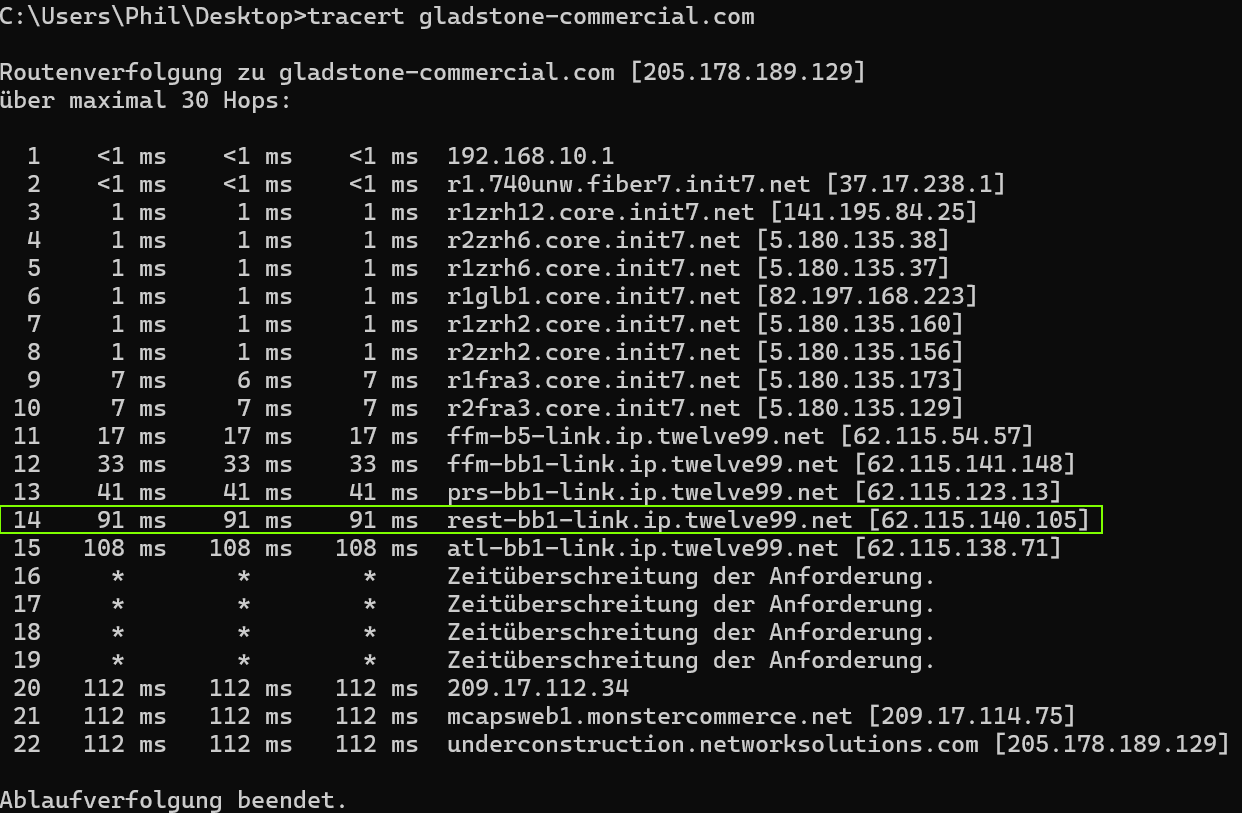
Here I prepared a traceroute from Switzerland to Gladstone Commercial in the United States. Hop 14 is particulary interesting: after passing through Paris, the route crosses the Atlantic and reaches Reston, Virginia, with a RTT of just 91 ms. Which is - awesome. Traceroute uses IPv4.
Seen that, this means that a packet can travel from Switzerland accross the Atlantic to the United States and back in less than a tenth of a second. this demonstrates us the speed of modern fiber-optic networks.
How about a traceroute to YOUTUBE.com
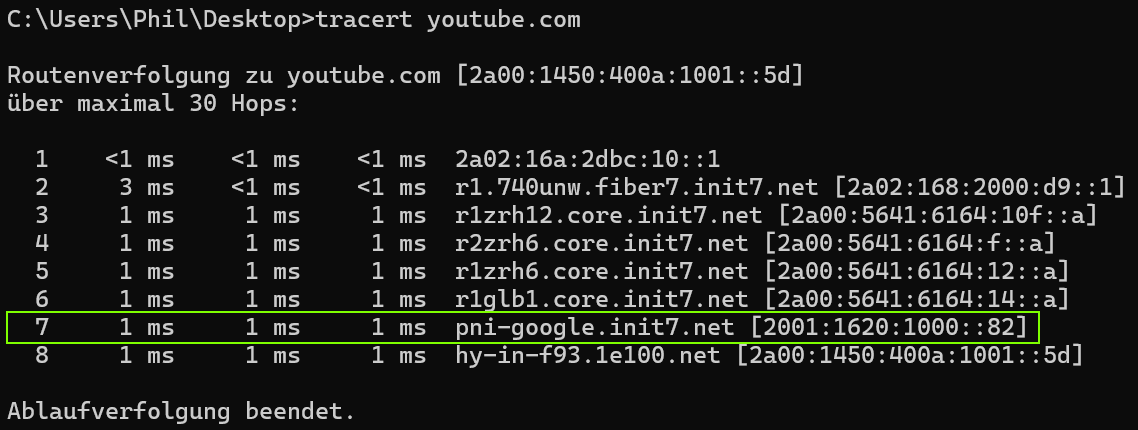
While the Gladstone Commercial traceroute uses IPv4* (yes... 06.09.2026 and an american company has not yet a quad A rec...shame on them...) and travels accross the Atlantic, the YouTube connection uses IPv6 and reaches Google in just around 1 ms RTT. This extremly low latency is possible because Init7 has direct peering with Google, keeping the traffic local instead of sending it through multiple transit networks all over the world. It is a great example of how efficient peering can dramatically shorten the network path.
Isn't that cool? 1 ms vs. 112 ms just with direct peering. In this demonstration Hop 7 is telling us that it's a public network interconnect. Init7 is peering with Google.
One thing to remember: youtube.com (or basically any address), does not tell you if there is a direct peering behind it or not. CDNs reduce latency even further by caching and serving content from locations close to the end user, minimizing the physical distance the data has to travel.
Note: The huge latency difference between these two examples is not caused by IPv4 versus IPv6 - It is primarily a matter of routing, peering, and physical distance. No matter how much bandwidth a fiber connection provides, it cannot overcome the laws of physics.